
You’ve probably experienced this cycle before.
You decide things are going to change.
Monday arrives.
New training programme.
New diet.
New routine.
This time, you’re doing everything properly.
You’re highly motivated.
For two weeks, everything goes brilliantly.
Then work becomes busy.
You sleep badly.
Something unexpected happens.
The five-session training programme becomes three sessions.
Then one.
Then none.
A few weeks later, you’re waiting for another burst of motivation so you can start again.
The problem isn’t necessarily that you lack discipline.
The problem may be that your plan only works when life is going perfectly.
Motivation Is Useful — But Unreliable
Motivation feels powerful because it creates momentum.
Use it when it’s there.
The problem is expecting it to remain there permanently.
Feelings change.
Some mornings you’ll genuinely want to train.
Others you’ll find almost anything more appealing.
If your entire fitness strategy requires you to feel motivated before taking action, consistency becomes extremely difficult.
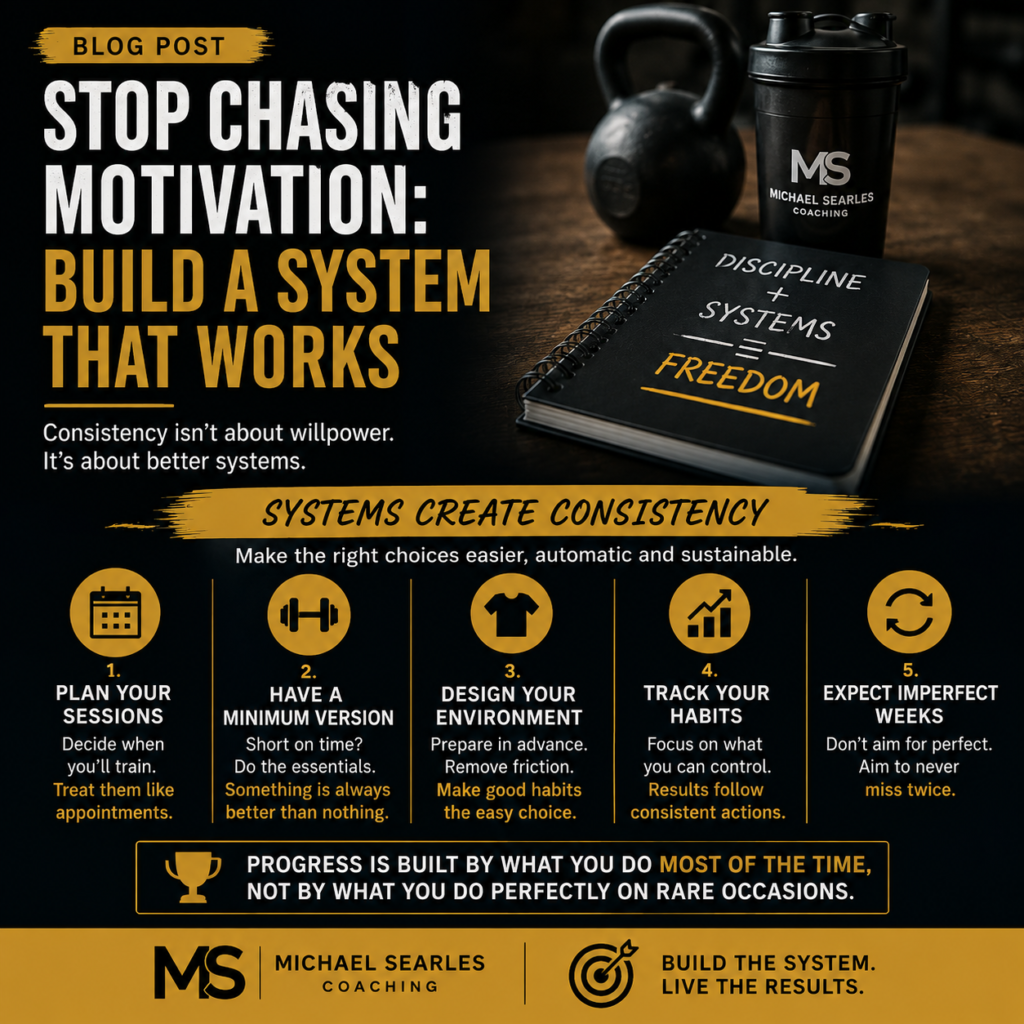
Instead, we can create systems that reduce the number of decisions required.
Make Training an Appointment
Don’t simply tell yourself:
“I’ll train three times this week.”
Decide when.
Monday at 7:00.
Wednesday at 18:00.
Saturday at 10:00.
You’ve transformed a vague intention into an appointment.
Of course, life occasionally interferes.
But having a default schedule removes the daily negotiation about whether you’re going to train.
You already decided.
Now you execute.
Have a Minimum Version of Your Programme
People frequently fall into all-or-nothing thinking.
No time for a 60-minute workout?
Then apparently there’s no point training at all.
That’s a mistake.
Create a minimum version of your routine.
Your ideal session might last an hour.
Your minimum session might be 25 or 30 minutes consisting of the four most important exercises.
Some weeks you’ll perform the ideal programme.
Occasionally you’ll perform the minimum.
Both maintain the habit.
A successful 30-minute workout is considerably more useful than the perfect 60-minute workout you never performed.
Design Your Environment
Willpower becomes less important when your environment supports the behaviour you’re trying to create.
Make desirable behaviours easier.
Prepare your gym clothes the night before.
Keep useful foods readily available.
Choose a gym that’s practical to reach.
Schedule training before your diary fills up.
Have your programme ready before entering the gym.
Remove unnecessary friction.
Good systems make the desired behaviour easier to execute.
Track Things You Can Control
Body weight fluctuates.
Progress photographs take time to change.
Strength doesn’t increase every session.
If these are your only measures of success, motivation can disappear quickly.
Instead, also measure behaviours.
Did you complete your planned sessions?
Did you eat appropriately most of the week?
Did you stay active?
Did you get sufficient sleep?
Did you follow your programme?
These are actions you can directly influence.
Physical results tend to emerge from repeating those behaviours over time.
Expect Imperfect Weeks
Consistency doesn’t mean never missing a workout.
It doesn’t mean eating perfectly every day.
And it certainly doesn’t mean your life has to revolve around fitness.
You’ll travel.
You’ll get busy.
You’ll have stressful periods.
You’ll occasionally become ill.
Plans will change.
The skill isn’t avoiding every possible disruption.
It’s becoming very good at returning to your routine quickly.
One missed session doesn’t need to become three missed weeks.
One restaurant meal doesn’t require an entire weekend of overeating.
One difficult week doesn’t mean you need another dramatic Monday restart.
Just continue.
Stop Restarting
This is one of the most useful mindset changes you can make.
You don’t constantly need to start again.
Fitness isn’t a 12-week event followed by normal life.
It’s part of normal life.
There will be periods when you train more.
There will be periods when you train less.
The important thing is maintaining enough continuity that every disruption doesn’t send you back to the beginning.
Progress rarely looks like a perfectly straight line.
Build Something You Can Repeat
The most impressive programme on paper is useless if it doesn’t fit your actual life.
A good programme should challenge you, but it should also acknowledge your:
Schedule.
Responsibilities.
Experience.
Preferences.
Goals.
Recovery.
Available equipment.
That’s one of the reasons personalised coaching can be valuable.
The question isn’t simply:
“What’s the theoretically optimal programme?”
It’s:
“What’s the most effective programme this person can consistently execute?”
Those aren’t always the same thing.
And over months and years, consistency has an enormous advantage.
You don’t need to feel motivated every day.
You need a system that keeps you moving when motivation inevitably disappears.
TURN YOUR GOALS INTO A PLAN
Personalised training and coaching built around your goals, lifestyle and experience.
Explore coaching with Michael Searles.