
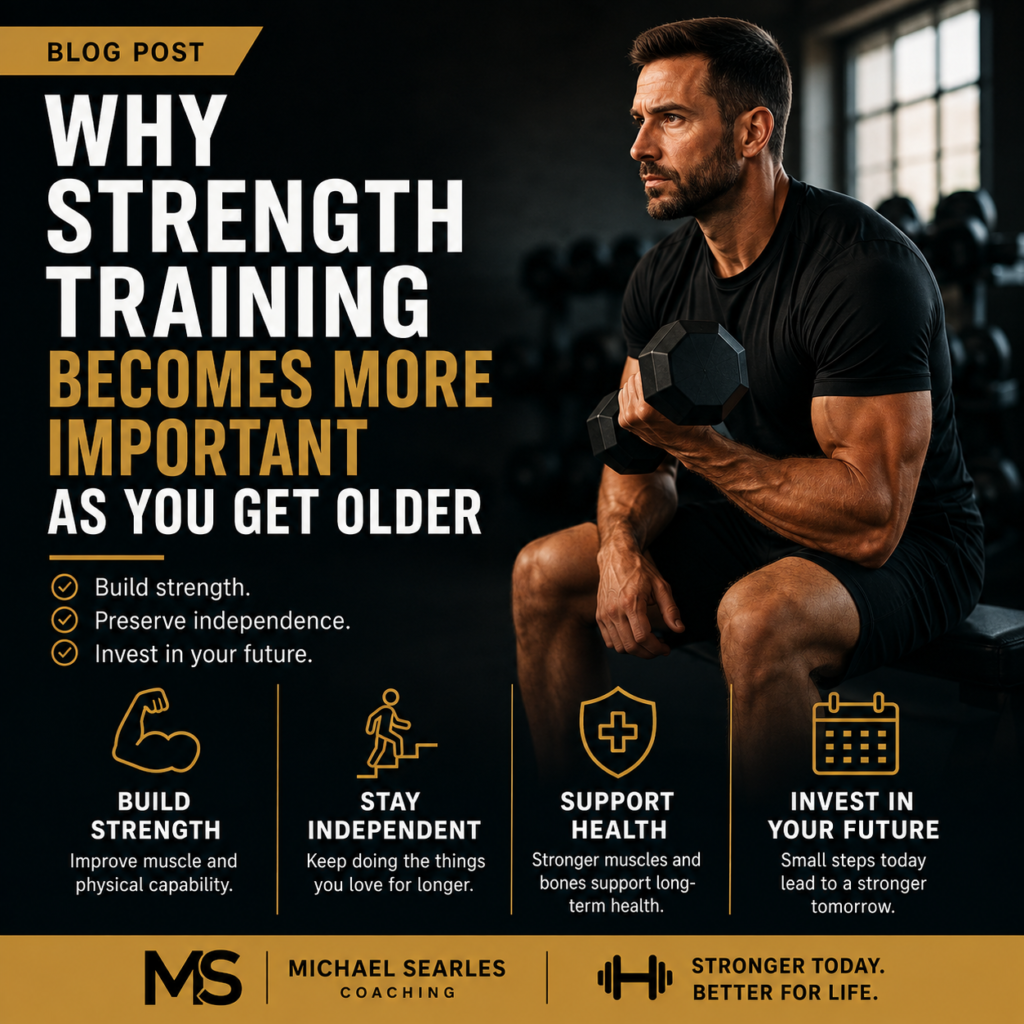
Getting older is unavoidable.
Becoming weak, inactive and physically incapable doesn’t have to be.
One of the most valuable investments you can make in your future health is maintaining your strength, muscle mass and physical capability.
Strength training is often associated with aesthetics — building muscle, developing stronger legs or creating a leaner physique.
Those can certainly be benefits.
But the real value of strength training extends far beyond what you see in the mirror.
As we move through adulthood, maintaining our physical capacity becomes increasingly important.
Muscle Is About More Than Appearance
Skeletal muscle allows us to move.
It helps us climb stairs, carry shopping, lift luggage, play sport, get off the floor and perform countless everyday activities that are easy to take for granted when we’re younger.
Maintaining sufficient muscle and strength therefore gives us something incredibly valuable:
Physical independence.
You don’t need to become a bodybuilder.
For most people, the objective is much simpler.
Develop enough strength and physical capacity to continue doing the things you enjoy for as long as possible.
Strength Is Your Physical Reserve
One of my favourite ways to think about strength is as a reserve capacity for life.
Imagine carrying two heavy shopping bags currently feels difficult.
If you spend the next year becoming significantly stronger, those bags haven’t changed.
You have.
The same task now represents a smaller percentage of your maximum physical capacity.
This applies to countless aspects of everyday life.
Lifting luggage.
Walking up stairs.
Moving furniture.
Playing with children or grandchildren.
Getting yourself off the floor.
The stronger and more capable you are, the less demanding many ordinary physical tasks become.
Your Body Needs a Reason to Stay Strong
The body adapts to what we repeatedly ask it to do.
If we stop challenging our muscles, there’s little reason for the body to maintain physical capabilities that are no longer required.
Resistance training provides that challenge.
Exercises such as squats, presses, rows, hinges, lunges and loaded carries can progressively challenge the muscles while developing useful movement skills.
The important word is progressively.
Doing exactly the same workout, with exactly the same resistance, indefinitely gives the body relatively little reason to continue adapting.
A properly designed programme evolves as you do.
Resistance can increase.
Repetitions can change.
Exercises can become more challenging.
Training volume can be adjusted.
The objective is continued progress rather than simply repeating workouts.
Don’t Forget Your Bones
Resistance training doesn’t only challenge muscle.
Loading the body also places mechanical stress on bone.
Alongside appropriate nutrition and other lifestyle factors, resistance and weight-bearing exercise can therefore form an important part of maintaining musculoskeletal health as we get older.
And this is where the conversation around training needs to change.
Exercise isn’t simply something we do because we want to look better this summer.
It’s something we can use to protect our future physical capabilities.
You Don’t Need to Train Every Day
More isn’t automatically better.
For many people, a few well-structured resistance-training sessions each week can provide an excellent foundation.
The appropriate amount depends on the individual.
Your age.
Training history.
Goals.
Schedule.
Recovery.
Lifestyle.
Previous injuries or limitations.
A programme should reflect those factors rather than forcing everybody into the same routine.
And consistency matters far more than occasional extreme effort.
Two or three intelligently designed sessions performed consistently over months and years will generally achieve considerably more than an aggressive programme you abandon after three weeks.
Cardio Still Matters
Strength training isn’t an argument against cardiovascular exercise.
Both matter.
Cardiovascular fitness supports your ability to perform sustained activity, while resistance training develops qualities such as strength and muscular capacity.
Walking matters.
Cardiovascular training matters.
Mobility matters.
Nutrition matters.
Sleep matters.
Strength training simply deserves a prominent place within that bigger picture — particularly as maintaining physical capability becomes increasingly important.
Train for the Person You Want to Be Later
It’s easy to train exclusively for short-term goals.
A holiday.
A wedding.
A photograph.
A number on the scale.
There’s nothing wrong with having those goals.
But I’d encourage you to think further ahead as well.
Train so you can travel.
Train so you can carry your own luggage.
Train so stairs don’t become intimidating.
Train so you can get off the floor comfortably.
Train so you can continue enjoying sport and physical activity.
Train so your future world remains as large as possible.
And yes — train because feeling strong is pretty good too.
Strength isn’t just something you build for today. It’s something you invest in for the decades ahead.
BUILD YOUR STRONGER FUTURE
Looking for a training programme designed around your goals, experience and lifestyle?
Explore personalised coaching with Michael Searles.