Fat loss has somehow become incredibly complicated.
Detoxes.
Fasting protocols.
Fat-burning supplements.
Foods you’re supposedly never allowed to eat again.
Thirty-day transformations.
And an endless stream of social-media advice telling you that one particular food, hormone or training method is the reason you haven’t achieved your goal.
Yet underneath all that noise is a much simpler principle:
Fat loss requires an energy deficit over time.
That doesn’t mean the process is always easy.
Human behaviour, appetite, lifestyle, environment and individual circumstances make nutrition considerably more complicated than a simple equation.
But understanding the fundamentals allows us to stop searching for shortcuts and start building an approach we can actually maintain.
Calories Matter — But Context Matters Too
Your body uses energy every day.
Energy is required to keep you alive, maintain your tissues, digest food and perform physical activity.
When energy intake remains below energy expenditure over time, stored energy can be used and body mass tends to decrease.
That doesn’t mean everybody needs to obsessively count every calorie forever.
It means we shouldn’t pretend energy balance doesn’t exist.
The better question is:
How can we create an appropriate calorie deficit without making your life miserable?
That’s where food selection, protein, activity, training and behaviour become particularly useful.
Prioritise Protein
Protein deserves particular attention when improving body composition.
It provides amino acids required by the body and supports the maintenance and development of muscle tissue.
Protein-rich foods can also help create satisfying meals.
Practical options might include:
Eggs.
Fish.
Lean meat.
Poultry.
Greek yoghurt.
Cottage cheese.
Tofu and other soy foods.
Beans and lentils.
And protein supplements where they’re useful and convenient.
Exact requirements vary between individuals.
But making sure your main meals contain a meaningful source of protein is a useful starting point for many people.
Don’t Diet So Hard That You Can’t Train
One of the most common mistakes I see is trying to lose weight as quickly as possible.
Food intake plummets.
Energy disappears.
Training performance suffers.
Hunger increases.
The diet becomes increasingly difficult to maintain.
Eventually the person abandons it altogether.
Then, a few months later, another extreme approach begins.
A more moderate strategy may produce less dramatic changes from one week to the next, but sustainability matters.
Remember:
You’re not trying to become brilliant at dieting. You’re trying to achieve a result you can maintain when the diet ends.
Strength Training Belongs in a Fat-Loss Programme
If improving body composition is the objective, don’t make exercise exclusively about burning calories.
Resistance training gives us an opportunity to develop or preserve muscle while nutrition creates the conditions required for fat loss.
That’s an important distinction.
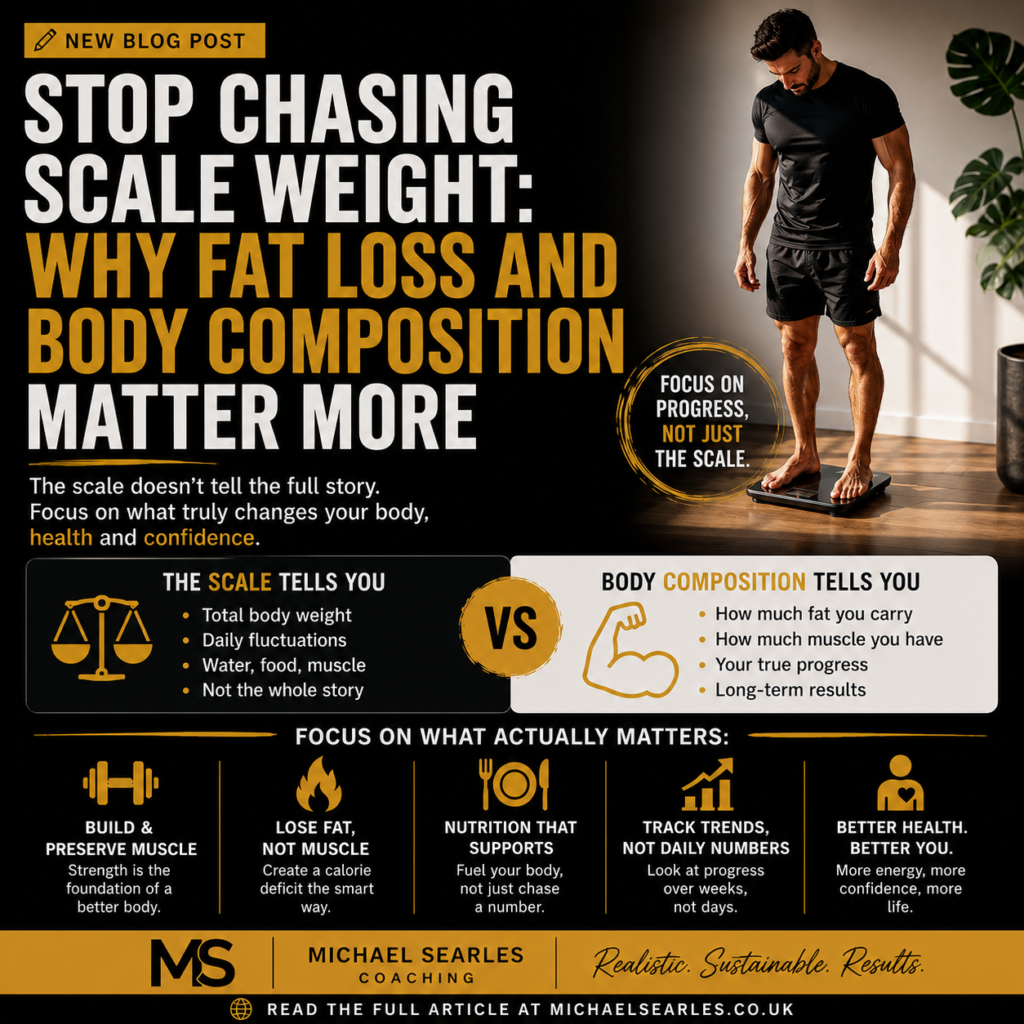
The goal isn’t necessarily to make the number on the scale as small as possible.
For many people, what they actually want is to become:
Leaner. Stronger. Fitter. Healthier.
Those goals require us to look beyond body weight alone.
Walking Is Seriously Underrated
Not every calorie needs to be burned through an exhausting workout.
Walking is accessible, relatively easy to recover from and can substantially increase daily activity when performed consistently.
Take the stairs.
Walk during phone calls.
Get outside after lunch.
Walk part of your commute where practical.
Park slightly further away.
Small behaviours repeated hundreds of times can make a surprisingly meaningful difference.
You don’t need every activity to feel like a workout for it to count.
Stop Trying to Be Perfect
A sustainable nutrition plan needs room for real life.
Birthdays happen.
Restaurants happen.
Holidays happen.
There will occasionally be pizza.
None of these things automatically destroys your progress.
The ability to return to your normal habits afterwards is considerably more valuable than trying to maintain dietary perfection indefinitely.
If you’re consistent most of the time, occasional flexibility can exist within a successful approach.
Monitor Progress Properly
Body weight can be useful, but don’t become emotionally attached to individual readings.
Weight naturally fluctuates.
Instead, look at trends over time.
Depending on your goals, other useful measures might include:
Waist measurements.
Progress photographs.
How your clothing fits.
Gym performance.
Fitness.
Energy levels.
And, importantly, how consistently you’re actually following the plan.
No single measurement tells the entire story.
The Best Diet Is One You Can Actually Live With
Successful fat loss isn’t about suffering harder than everybody else.
It’s about establishing the appropriate conditions and maintaining them for long enough.
Eat mostly nutritious foods.
Consume adequate protein.
Strength train.
Stay active.
Sleep properly.
Monitor progress.
Adjust when necessary.
And leave enough flexibility to still have a life.
The goal isn’t simply losing weight. It’s reaching a result without creating a lifestyle you can’t wait to escape from.
BUILD A SUSTAINABLE PLAN
Need a structured approach to training and nutrition built around your lifestyle?
Explore personalised coaching with Michael Searles.